
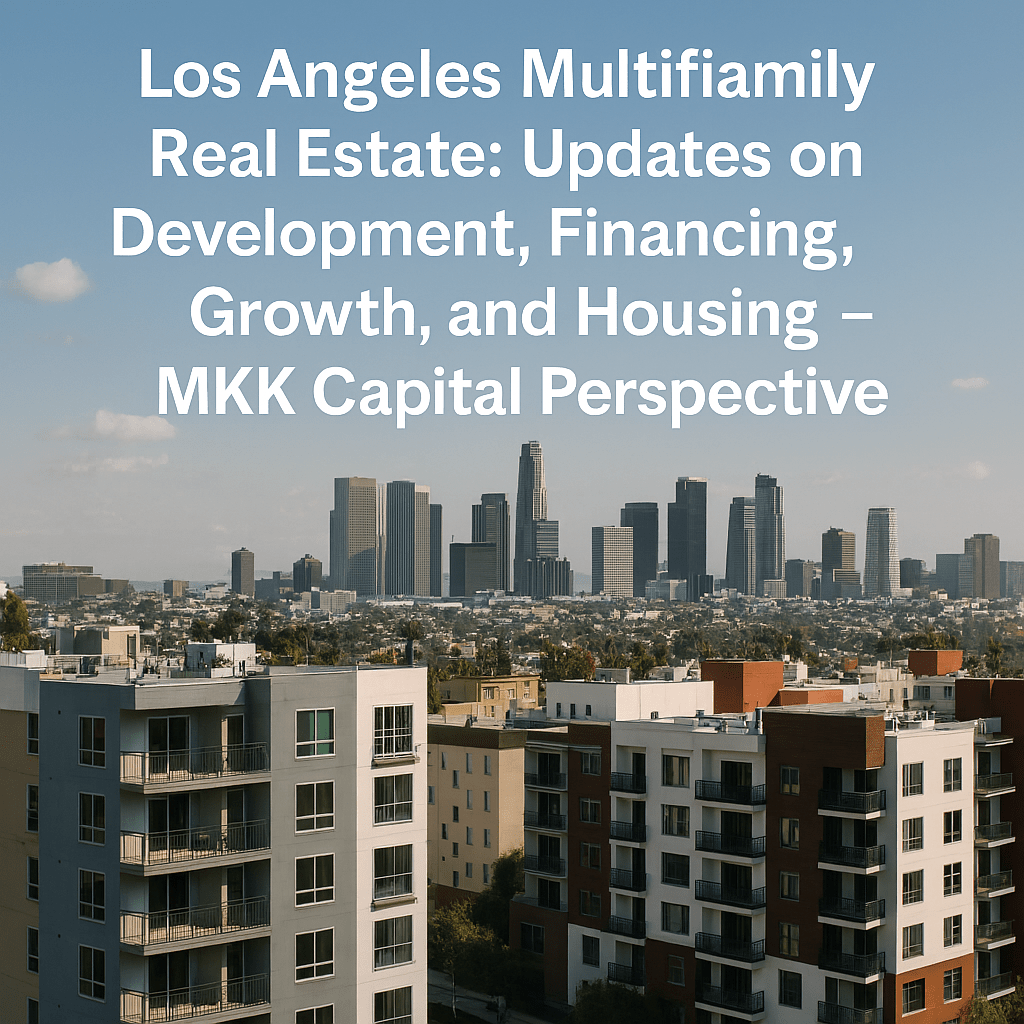
Los Angeles multifamily real estate update Overview
Here is Los Angeles multifamily real estate update. Los Angeles remains one of the nation’s most dynamic multifamily markets. Strong demand, evolving demographic trends, constrained land supply, and shifting policy priorities — along with growing institutional interest — are driving activity across development, investment, and financing. For capital providers such as MKK Capital, the market offers both opportunity and complexity: attractive cash flow and appreciation potential balanced by regulatory risk, construction cost pressure, and localized affordability mandates.
Market Fundamentals
Demand for multifamily housing in Los Angeles is supported by population growth in core submarkets, household formation among young professionals, and downsizing among older residents. Immigration and continued job concentration in tech, entertainment, healthcare, and creative industries sustain rental demand. Supply remains constrained due to geography, limited developable land, and community opposition, although zoning changes and transit-oriented development incentives aim to increase inventory over time. Rents have stabilized following pandemic volatility, with moderate growth in high-demand submarkets such as Downtown LA, Koreatown, West Hollywood, Culver City, and Hollywood. Class A assets near transit and major employment centers command premiums, while Class B and C properties maintain steady demand from cost-conscious renters. Affordability pressures continue to intensify, bringing workforce and affordable housing to the forefront of policy discussions, with inclusionary requirements and rent stabilization measures influencing project feasibility.
Key Development Areas
Downtown Los Angeles continues to densify with mixed-use towers, adaptive reuse projects, and office-to-residential conversions, driven by demand for walkable, amenity-rich environments. Koreatown and Mid-Wilshire attract developers due to their central location, transit access, and high renter populations, supporting mid-rise and boutique multifamily projects. West Los Angeles and Westside submarkets such as Culver City, Palms, and Sawtelle benefit from proximity to Silicon Beach, entertainment studios, and transit improvements, fueling interest in higher-end multifamily and mixed-use developments. The South Bay and Long Beach corridors appeal to families and commuters seeking more space, supported by transit investments and industrial growth. The San Fernando Valley and Northeast LA offer more affordable land and zoning flexibility, encouraging garden-style and mid-rise development aimed at middle-income renters.
Policy and Regulatory Environment
California’s RHNA mandates and local zoning reforms aim to accelerate housing production, with Los Angeles adopting streamlined approvals in certain corridors through programs such as Transit Oriented Communities incentives. However, affordability requirements and fees continue to influence project economics. Rent stabilization frameworks and tenant protection measures add operational considerations for acquisitions and repositioning strategies. Environmental and design requirements — including CEQA compliance, green building standards, and electrification mandates — lengthen development timelines and increase costs but support long-term sustainability and operating efficiency.
Financing Landscape
Debt markets have tightened since 2022 due to interest rate volatility, leading to stricter underwriting and longer debt terms. By late 2024–2025, lender liquidity improved and floating-rate exposure decreased, though cap rate normalization and conservative loan-to-value ratios remain common. Construction loans face heightened scrutiny, with lenders requiring stronger pre-leasing, experienced general contractors, and larger contingency reserves. Equity appetite remains strong among institutional and private investors seeking stable returns and inflation hedging, with value-add and stabilization strategies attracting significant interest. Agency lenders such as Fannie Mae and Freddie Mac remain competitive for stabilized assets, particularly those with affordability components. Alternative capital sources — including life companies, insurance firms, mezzanine debt, preferred equity, opportunity zone capital, and private credit funds — play an expanding role. Public financing tools such as LIHTC, municipal bonds, and local housing trust funds are essential for affordable and workforce housing, often blended with private capital to meet inclusionary requirements.
Growth Drivers and Investment Themes
Transit-oriented and mixed-use developments benefit from zoning incentives and renter demand for transit access and amenities. Adaptive reuse and office-to-residential conversions offer efficient pathways to add housing in areas with declining office demand. Purpose-built rentals and specialized housing types — including student and creative workforce housing — provide diversification and capture premium rents. Sustainability and resilience measures, including energy-efficient design and all-electric construction, are increasingly standard and can unlock incentives while reducing long-term operating costs. Value-add repositioning strategies focused on amenity upgrades, operational improvements, and selective capital enhancements remain central to boosting NOI and asset value.
Risks and Headwinds
Regulatory uncertainty around zoning, tenant protections, and fee structures can significantly impact project feasibility and returns. Construction and labor costs remain elevated due to supply chain disruptions and skilled labor shortages, extending timelines and increasing budgets. Interest rate and capital market volatility continue to pressure valuations and complicate refinancing of short-term loans. Market segmentation risk persists, with potential oversupply in certain submarkets or product types — such as luxury condos — posing challenges to returns.
MKK Capital Positioning and Strategies
MKK Capital is best positioned by focusing on core-plus and value-add multifamily assets in transit-rich, employment-dense submarkets where demand and rent growth remain resilient. Prioritizing assets with repositioning potential — through operational improvements, amenity enhancements, or modest capital expenditures — can generate outsized NOI gains without requiring major redevelopment. Blended financing strategies combining agency permanent loans, conservative construction debt, and private equity or Los Angeles multifamily bridge loans help maintain flexibility. Early engagement with planning and public agencies reduces entitlement risk and maximizes incentives such as fee waivers and density bonuses. Strategic incorporation of affordability requirements, supported by LIHTC and other subsidies, can improve yields and reduce regulatory exposure. Interest-rate risk can be mitigated through fixed-rate long-term debt for stabilized assets and rate caps for construction loans. Strong relationships with experienced general contractors and cost consultants help control budgets and schedules. Sustainability measures enhance long-term operating efficiency and appeal to ESG-focused institutional investors.
Outlook (12–36 Months)
The Los Angeles multifamily market is expected to experience moderate rent growth, particularly in well-located, amenity-rich properties. Class A and well-positioned Class B assets are likely to outperform commodity Class B and C properties in peripheral areas. Institutional capital will continue flowing into the sector, though underwriting will remain disciplined. Opportunities may arise for buyers where owners face refinancing challenges. Affordable housing will remain a major policy priority, supported by public subsidies and regulatory mandates. Investors who combine local market expertise, conservative financing structures, and strong operational capabilities will be best positioned to navigate regulatory complexity and cost pressures.
Los Angeles multifamily real estate update
Los Angeles multifamily real estate offers durable long-term fundamentals driven by constrained supply and sustained demand, but success requires careful navigation of regulatory, financing, and construction risks. For MKK Capital, disciplined underwriting, a focus on transit-accessible and value-add opportunities, strategic use of blended capital stacks, and proactive engagement with public partners provide a practical roadmap to capture upside while mitigating downside.
MKK capital are Los Angeles hard money lenders offering California commercial Bridge loans to investors. Call today.